Partner Lilian Harris
Queer Places:
University of Cambridge, 4 Mill Ln, Cambridge CB2 1RZ
St Mary the Virgin Churchyard, Church St, Kirkby Lonsdale, Carnforth LA6 2AX, United Kingdom
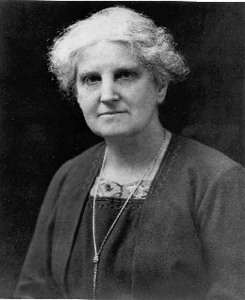 Margaret Caroline Llewelyn Davies (October 16, 1861 – May 28, 1944) was born on October 16, 1861, in Marylebone, London, the youngest of seven children born to Mary (née
Crompton) and the Reverend John Llewelyn Davies. Her father served as the vicar of Christ Church in Marylebone, a fellow of Trinity College, and a prominent Christian
socialist actively opposed to poverty and inequality who was involved in the early co-operative movement. Her family background deeply influenced her progressive outlook;
her aunt, Emily Davies, helped found Girton College, Cambridge, where Margaret studied from 1881 to 1883 after attending Queen's
College, London, while many of her extended relatives were heavily involved in the women's suffrage movement.
Margaret Caroline Llewelyn Davies (October 16, 1861 – May 28, 1944) was born on October 16, 1861, in Marylebone, London, the youngest of seven children born to Mary (née
Crompton) and the Reverend John Llewelyn Davies. Her father served as the vicar of Christ Church in Marylebone, a fellow of Trinity College, and a prominent Christian
socialist actively opposed to poverty and inequality who was involved in the early co-operative movement. Her family background deeply influenced her progressive outlook;
her aunt, Emily Davies, helped found Girton College, Cambridge, where Margaret studied from 1881 to 1883 after attending Queen's
College, London, while many of her extended relatives were heavily involved in the women's suffrage movement.
Before stepping into her historic co-operative career, Davies worked as a voluntary sanitary inspector and became deeply impressed by the co-operative theory of the
Rochdale Society of Equitable Pioneers. She joined the Marylebone Co-operative Society in 1886, quickly became secretary of its Co-operative Women's Guild group, and was
elected to the national executive committee a year later. Following joint research on profit-sharing workshops with her friend
Rosalind Mary Shore Smith, she was appointed General Secretary of the Co-operative Women's Guild in 1889, holding the
position until 1921. Neither she nor her close associate Lilian Harris ever drew a salary for their extensive work, which helped
keep the organization financially stable during turbulent periods. Her leadership marked a transformative turning point for the Guild, steering it from domestic activities
toward robust political engagement, social reform, and unprecedented growth.
During her tenure, Davies championed women's suffrage, collecting petition signatures from branches beginning in 1893, and pushed for broader social welfare and labor
rights. In 1909, she gave evidence to a royal commission on divorce law reform, leading the Guild to advocate successfully for gender equality in divorce laws despite facing
fierce opposition from conservative and Roman Catholic members of the wider co-operative movement, which temporarily resulted in the Central Board halting its annual grant.
Unflinching in her convictions, Davies also stood as a dedicated pacifist, serving on the general council of the Union of Democratic Control during the First World War.
Furthermore, she compiled the landmark 1915 book Maternity: Letters from Working Women based on firsthand accounts of pregnancy and childcare, and edited the 1931 collection
Life as we have Known it, which featured an introduction by her friend Virginia Woolf.
Following her retirement in 1921—an event that prompted Catherine Webb to write the early history of the Guild, The Woman with the Basket—Davies achieved a historic
milestone in 1922 by becoming the first woman to serve as President of the Co-operative Congress. She also co-founded the International Women's Co-operative Guild in 1921
alongside Honora Enfield (who succeeded her as general secretary) and chaired the Society for Cultural Relations with the USSR between 1924 and 1928.
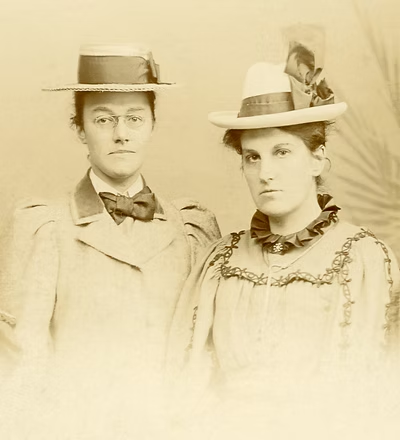
In her personal life, Davies shared a profound, lifelong partnership with Lilian Harris. The two met in Kirkby Lonsdale after the family moved there in 1889, where Harris
began working closely with Davies, eventually becoming the Guild's cashier in 1893 and its assistant secretary in 1901. Biographer Olive Banks noted that Lilian quickly
became much more than a co-worker, serving as Davies's lifelong friend, domestic partner, and administrative backbone. After Davies's father retired in 1908, Davies and
Harris moved to Hampstead to live together—with her father staying with them until his death in 1916—before eventually retiring to Dorking in Surrey. Davies passed away on
May 28, 1944, and was buried in the churchyard of St Mary the Virgin Church in Kirkby Lonsdale, leaving behind a legacy commemorated by plaques in Hampstead and Kirkby
Lonsdale as one of the most influential figures in the British co-operative and feminist movements.
References:
Other references:
- Davies, Margaret Llewelyn (Ed.). (1915). Maternity: Letters from Working Women. Co-operative Women's Guild / G. Bell and Sons.
- Davies, Margaret Llewelyn (Ed.). (1931). Life as we have Known it: By Co-operative Working Women. Hogarth Press. (Featuring an introduction by Virginia Woolf)
- Banks, Olive. (1985). The Biographical Dictionary of British Feminists: Volume 1, 1800–1930. Wheatsheaf Books. (Includes dedicated biographical coverage of Lilian Harris and Margaret Llewelyn Davies)
- Blaszak, Barbara J. (2000). Matriarchs of the Movement: Female Leadership and Gender Politics within the English Cooperative Movement. Syracuse University Press.
- Gaffin, Jean, & Thoms, David. (1993). Caring & Sharing: The Centenary History of the Co-operative Women's Guild. Central Books.
- Cohen, Ruth. (2020). Margaret Llewelyn Davies: With Women for a New World. Merlin Press.
- Webb, Catherine. (1927). The Woman with the Basket: The History of the Women's Co-operative Guild 1883–1927. Co-operative Printing Society.
- Joyce, P. (Ed.). (1972). Dictionary of Labour Biography: Volume 1. Macmillan. (Features an entry on Margaret Llewelyn Davies, pp. 93–98)
- Cole, G. D. H. (1944). A Century of Co-operation. Co-operative Union.
- Purvis, June. (2017). Book review of co-operative movement histories. The Times Literary Supplement.
Support this project
This website is a passion project researched, developed, and funded entirely by me. If you find the content valuable and would like to help support the ongoing research and hosting costs, any contribution is deeply appreciated.
Thank you for keeping this independent resource alive!
My books on Amazon: Elisa Rolle's books
BACK TO HOME PAGE
